Excavation Work
Trenches kill people who underestimated soil. Plan services first, classify the soil, choose the right protection, keep plant out of the zone of influence.
- > 1.5 m trench/shaft = HRCW; SWMS required before work starts.
- Dial Before You Dig + pothole if location uncertain.
- Spoil ≥ 1 m from edge; ladder within 7.5 m of every worker.
- "Hard compact" soil is the deceptive one — it looks safe and fails suddenly.
- No plant in the zone of influence unless shoring designed for it.
1. Who's responsible
PCBU doing the excavation — primary duty (s.19): plan, prepare SWMS, brief workers, supervise.
Principal Contractor (project ≥ $250k) — Reg 304: obtain underground essential services info before excavation; provide it to all excavating PCBUs; verify they understand it.
Designer — flag deep services, adjacent foundations, soil conditions in the safety report (Reg 295).
Worker — comply with SWMS; report changes (water, cracks, vibration, weather effects).
2. When this code applies
Definition: work to make, fill or partly fill excavations — trenches, shafts, tunnels. Excludes mines, bores under water law, interment trenches.
HRCW trigger (Reg 291): excavation depth > 1.5 m in shaft or trench, or any tunnel work. SWMS mandatory.
Excavation work is construction work — all construction duties apply (white card, induction, WHS Management Plan if PC project).
3. Pre-excavation planning
Underground services
- Dial Before You Dig (1100 / dialbeforeyoudig.com.au) before any excavation.
- Pothole with hand tools or vacuum excavation if cable/pipe location uncertain — confirm position before plant work.
- Electromagnetic locators / GPR acceptable if operators competent.
- Have a competent electrician on site for mechanical work near power.
Soil classification (by competent person)
| Type | Behaviour | Protection |
|---|---|---|
| Hard compact | Looks safe; cracks suddenly under moisture loss / water ingress / vibration. | Benching, battering, or shoring depending on depth. |
| Crack-prone (clay seams, shale) | Dries and shrinks; fails under stress, vibration, load. | Benching < 45° unless engineer-designed; shoring often required. |
| Loose / running (sand, gravel, silt) | No cohesion. Obvious risk. | Pre-installed sheet piling / closed sheeting / trench shields. Battering alone insufficient. |
| Groundwater-affected | Boils, undermining, pressure. | Shoring + dewatering (pumps, sumps). |
Site context
- Adjacent structures — consult designer / geotechnical engineer; document existing basements.
- Traffic / plant loads — establish the zone of influence: the soil volume affected by external loads. No plant or materials inside it unless shoring is designed for that load.
- Weather forecast — collapse risk rises sharply with rain.
SWMS development
- Identify hazards, hierarchy of controls, implementation, monitoring, review.
- Include rescue plan for collapse.
- Consult workers.
4. How trenches actually fail
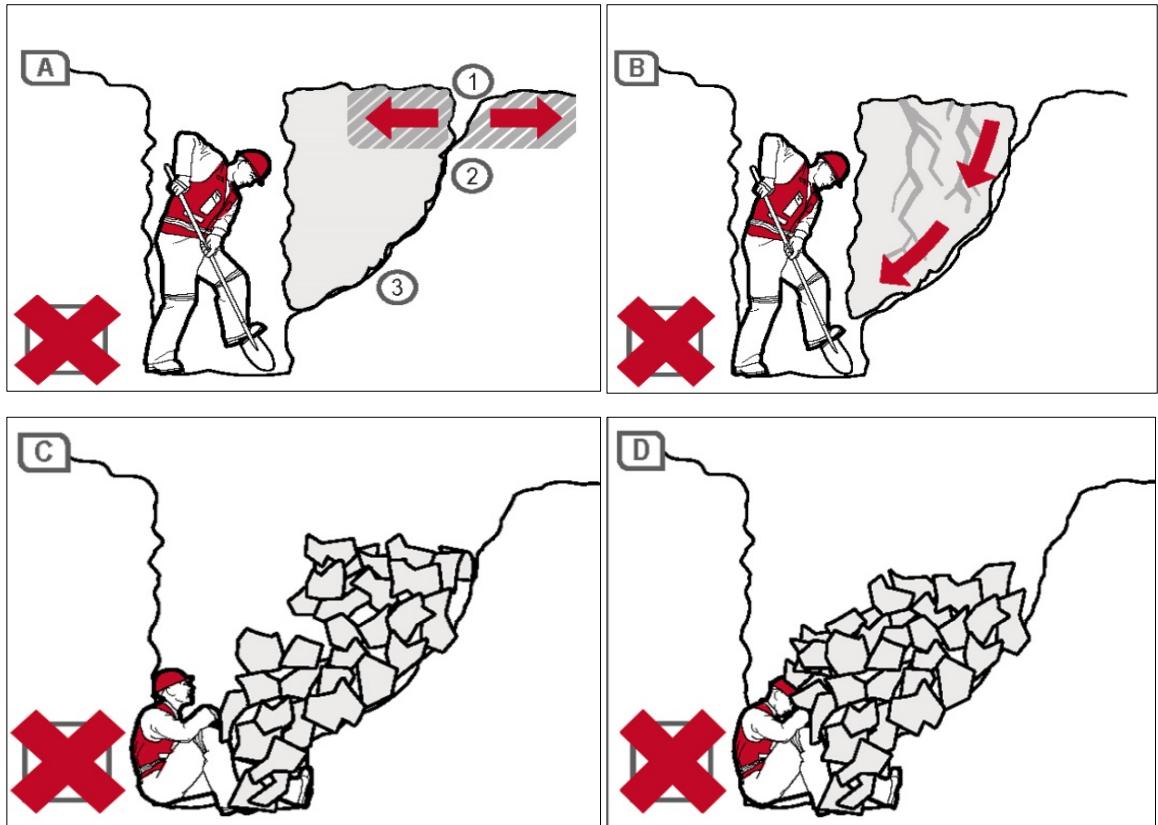 Figure 1 — Trench collapse mechanics. Tension cracks form behind the face; a wedge slips along a curved plane; a worker is buried in seconds. A cubic metre of saturated soil weighs ~1.5 t — enough to crush.
5. Zone of influence — keep plant clear
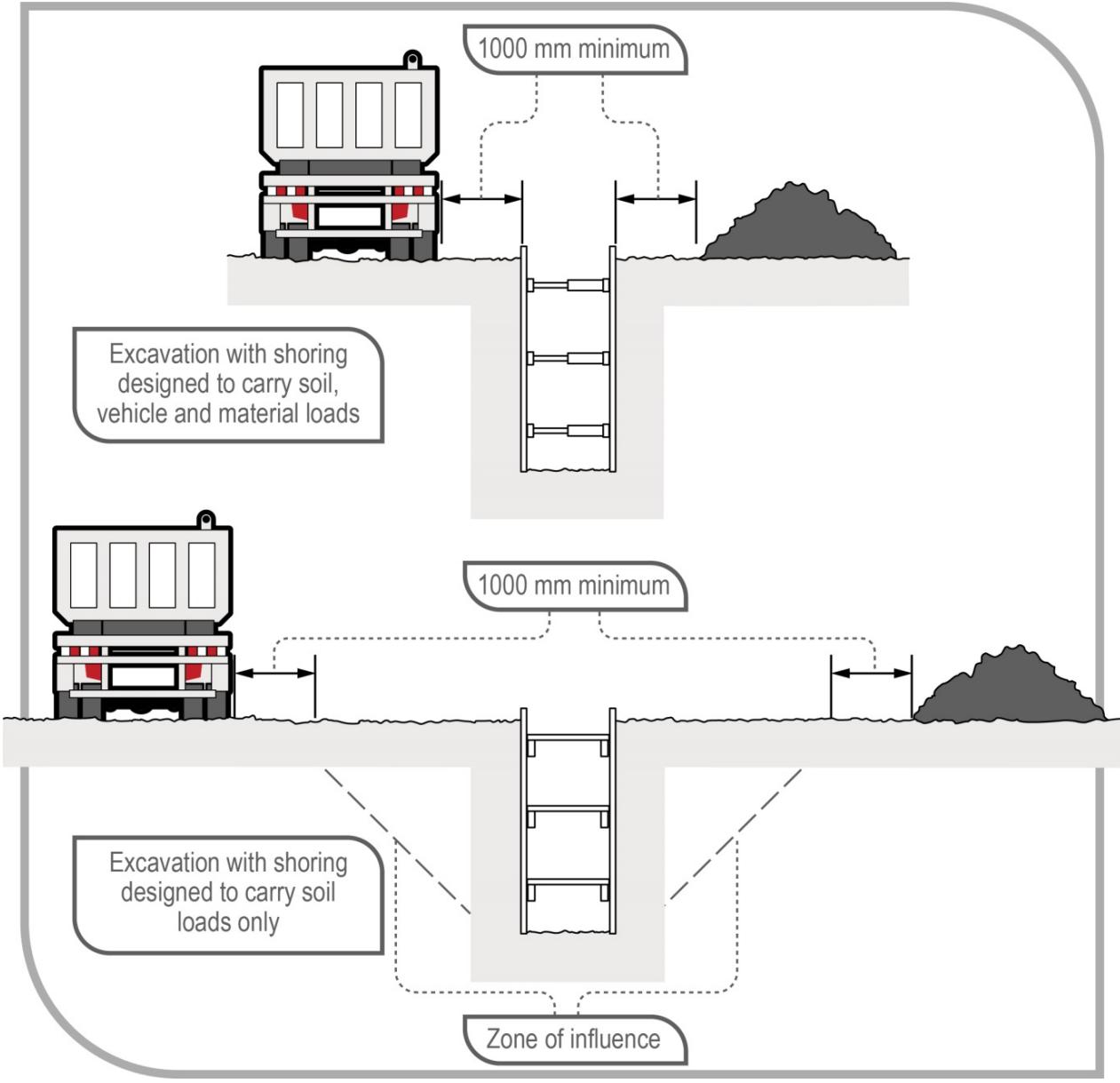 Figure 2 — Zone of influence with two shoring designs: shoring for face loads only (left) vs. shoring designed for vehicle loads (right). The boundary moves with depth and soil type.
- No plant, materials or stockpiles inside the zone unless shoring is engineer-designed for that load.
- Use wheel stoppers / barriers — solid enough to stop a fully laden machine.
- If plant must operate near the edge: geotechnical engineer certifies ground support for specific load magnitudes.
6. Shoring methods
Pick by depth, soil and access. Hierarchy by safety of installation:
Benching
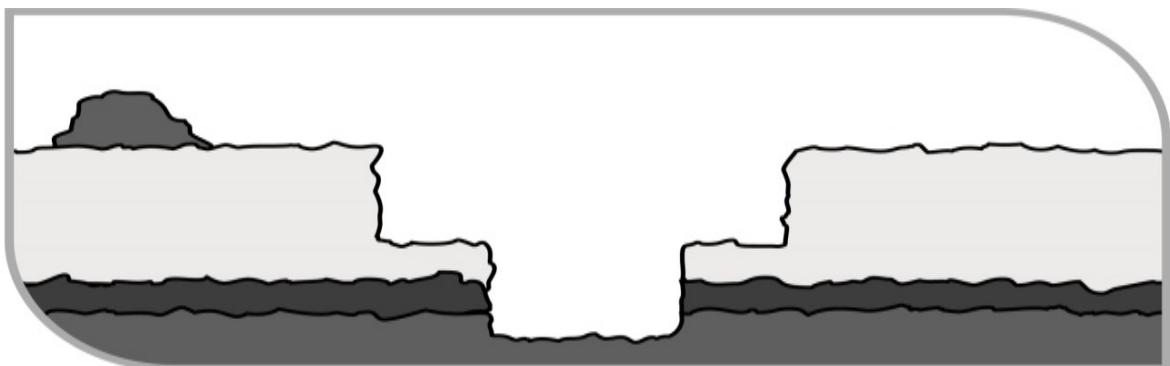 Figure 3 — Benching: stepped reduction of vertical face. Suits stable rock / stiff clay / dry ground. Bench width ≥ 1000 mm; sloped to drain. Cut from bottom up.
Battering
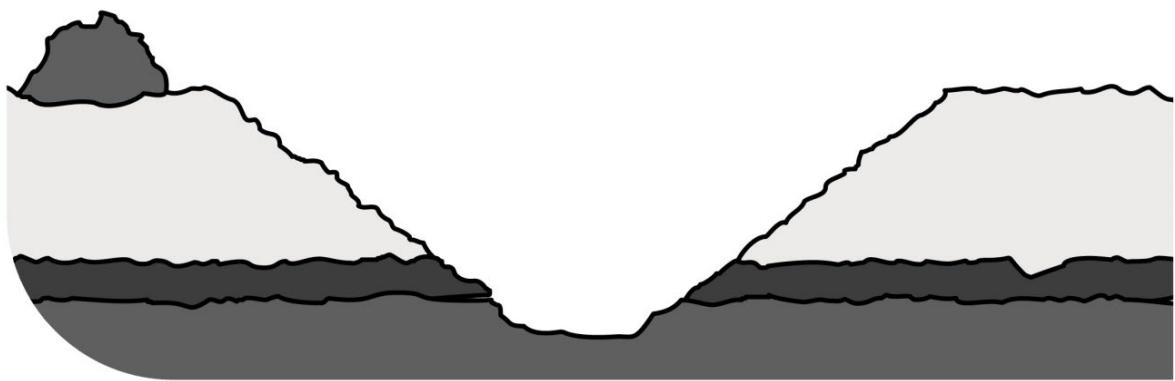 Figure 4 — Battering: sloped face. Angle < 45° unless engineer-designed. Suits granular soil, weathered rock, variable conditions. Often combined with benching.
Hydraulic shoring
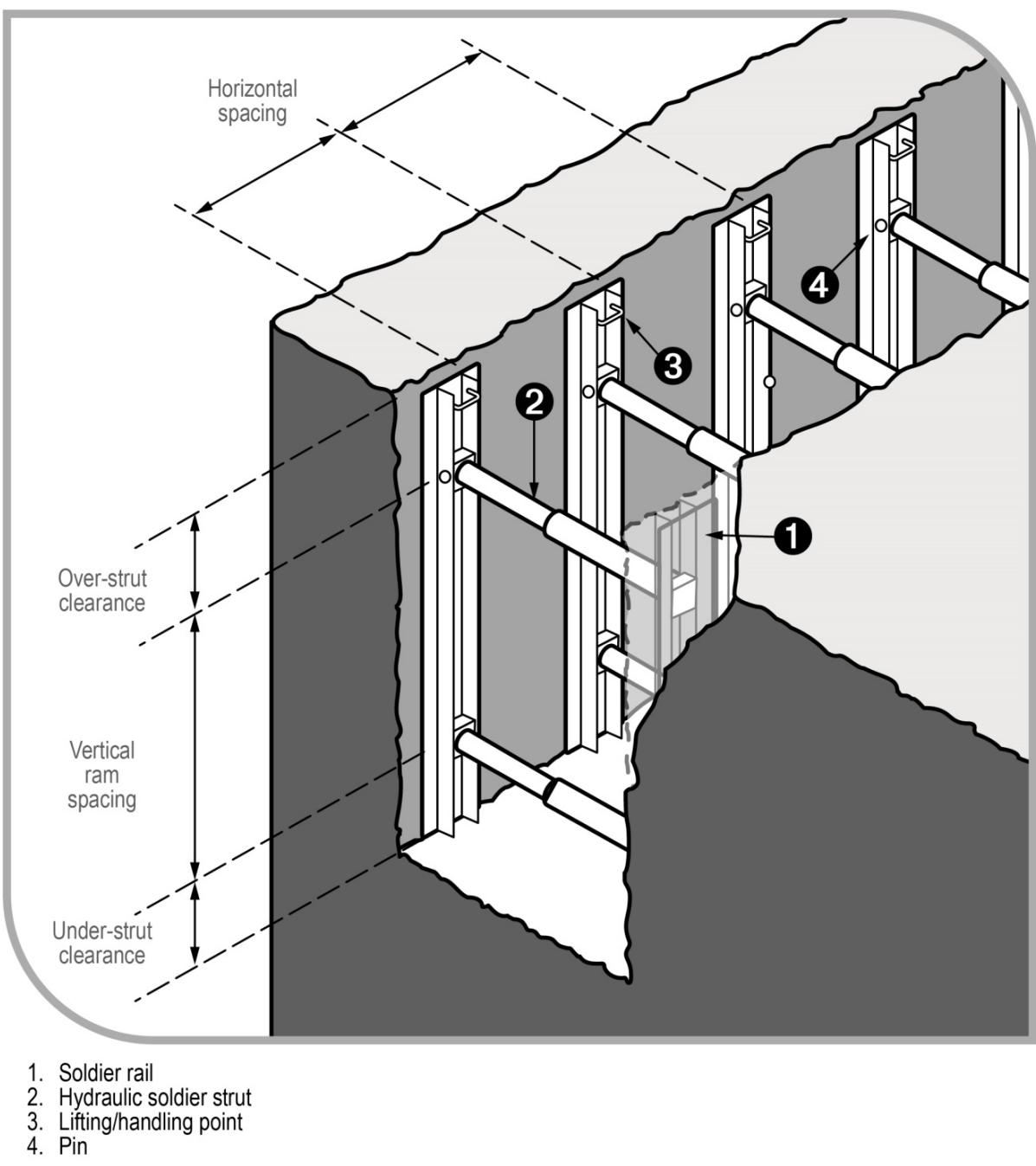 Figure 5 — Hydraulic shoring with jacks and struts. Designed by competent person for expected ground pressure. Inspect hoses/rams frequently — bent rams, abrasion, fatigue are common.
Timber soldier sets
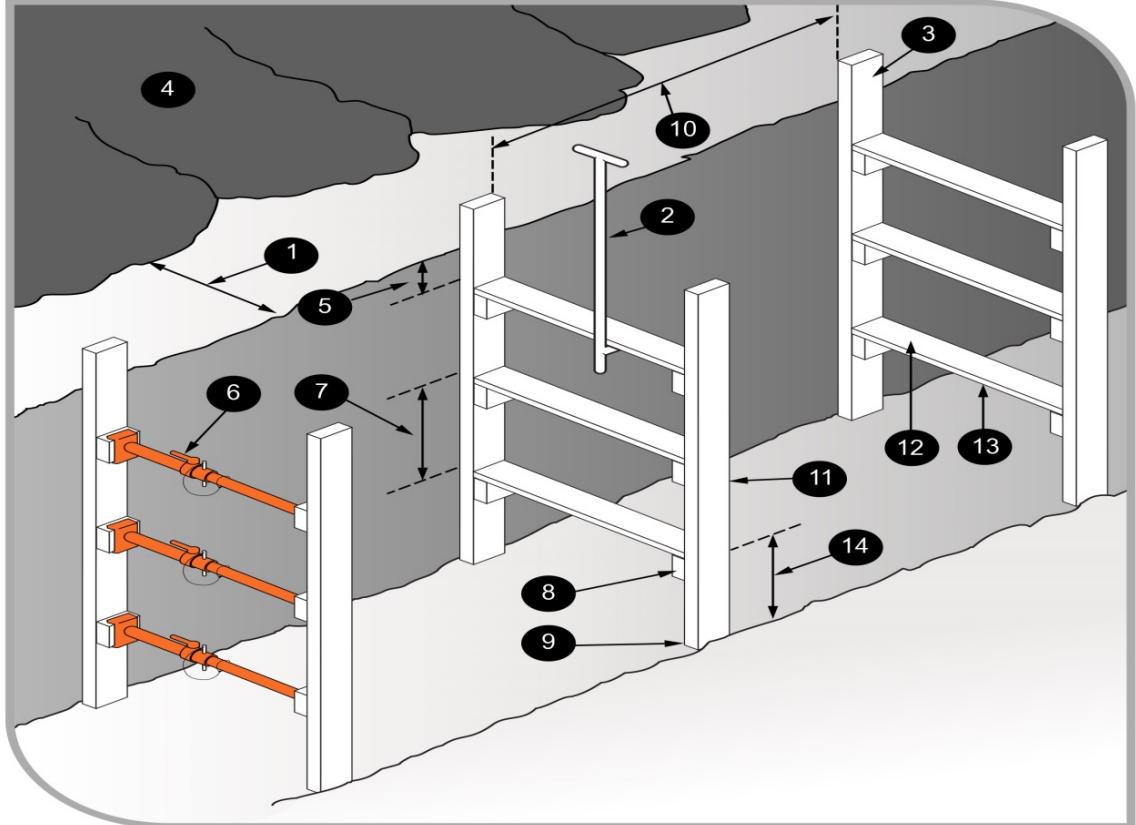 Figure 6 — Timber soldier sets. Soldiers (≥ 150 × 38 mm) at max 1.5 m centres. Toms (≥ 150 × 38 mm) at max 750 mm vertical, top tom projecting ≥ 300 mm above trench. Stable soils only — open sets don't fully support the face.
Sheet piling, trench sheeting, closed sheeting, ground anchors
- Steel sheet piling — major excavations, close to buildings, loose sand. Driven before excavation; supported by walings + jacks or tie-back anchors.
- Trench sheeting — lightweight; pneumatically driven; toms/wallings as work proceeds. High manual-handling/laceration risk during driving; control noise.
- Closed sheeting — continuous timber/metal planks for full face support; required where slippage between supports is a risk.
- Ground anchors (tie-backs) — resin/grout plugs in soil behind sheet piling, designed by geotechnical engineer.
Trench shields / boxes
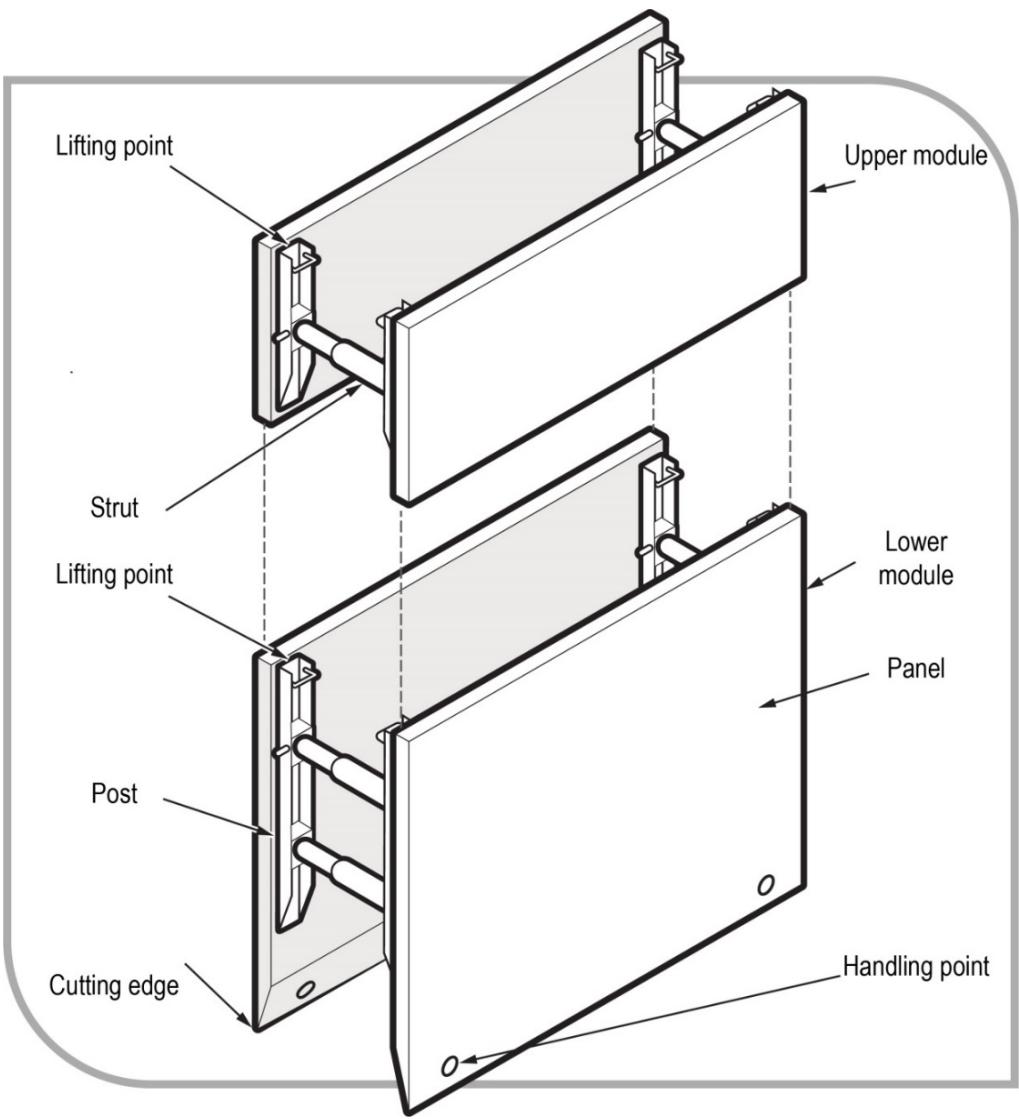 Figure 7 — Typical trench shield. Portable steel cage that protects workers from collapse; not a substitute for shoring of the face itself in unstable ground.
7. Spoil management
- ≥ 1 m clear of trench top (typical).
- Slope spoil away from edge to drain water away from face.
- High-side placement risks overload — prefer low-slope side; reduces effective excavation depth.
- "Angle of repose" for unsupported face fails — different soils slip at different slopes; never assume the natural pile slope is safe for a cut face.
8. Access & egress
- Ladder within 7.5 m of every worker in any excavation > 1 m.
- Ladder secured (tied/braced/weighted), full-width, extends ≥ 1 m above the step-off, positioned to prevent slipping.
- Ramps/steps: even, non-slip, adequate gradient; barriers/guards where used.
- Multiple emergency egress routes.
9. Atmospheric & confined-space considerations
- Deep trenches, tunnels, work near sewers/gas/fuel/contamination → potential for confined-space classification.
- Hazards: CO from engines, methane, H₂S, O₂ depletion, explosive atmospheres.
- Controls: mechanical ventilation (engineered), continuous gas monitoring, buddy/standby system, breathing apparatus where atmosphere unmanageable, prohibited combustion plant in occupied trenches.
- See §08 confined_spaces (Phase 3).
10. Hazard summary
| Hazard | Primary control | Secondary |
|---|---|---|
| Collapse | Engineer-designed shoring; benching/battering | Daily inspection (post-rain, post-vibration) |
| Falls into excavation | Guardrails, covers, shields, perimeter barriers | Rescue procedures |
| Water inrush | Dewatering pumps + sumps; drainage design | Slope to direct water away |
| Atmosphere | Mechanical ventilation; gas monitoring | Rescue prep, BA |
| Plant collision | Comms, blind-spot awareness, wheel stoppers | Hi-vis, alarms, lights |
| Service strikes | DBYD, potholing, locators | Insulated tools, vacuum excavation |
| Vibration / noise | Distance from pile-driving / blasting | HPDs, mufflers |
| Manual tasks | Mechanical plant > hand-dig where possible | Rotation, ergonomic tool use |
11. Records
- DBYD request and results — kept ≥ duration of excavation; 2 yrs if notifiable incident.
- Soil-classification report by competent person.
- Daily / pre-start inspection log — soil, shoring, water, adjacent structure status.
- SWMS (all revisions) + competent-person design certifications (shoring, batter angles, hydraulic capacity).
- Incident / near-miss records.
12. Common pitfalls / quick wins
Do
- Treat "hard compact" with the most suspicion — it fails suddenly and looks fine until it doesn't.
- Get a geotechnical report for any trench > 1.5 m. It's HRCW; the report justifies your shoring choice.
- Pothole before plant work. DBYD lists are not exact.
- Designed shoring first, then permit plant loads — never the reverse.
- Keep the spoil pile ≥ 1 m back; drain water away from the face.
- Have a written rescue plan before any worker enters; collapse rescue is a specialised confined-space operation.
- Provide secured ladders within 7.5 m of every worker.
Don't
- Skip the geotechnical or DBYD step "to save time".
- Assume natural slope = safe cut face.
- Allow a truck or excavator to swing within the unverified zone of influence.
- Run combustion plant inside an occupied deep trench.
- Resume work after rain / vibration without re-inspecting the face and shoring.
- Rely on a trench shield to fix face instability — shields protect occupants, not the face itself.
13. Cross-references
- See also: general_construction_work, demolition_work
- Confined space (deep trenches): confined_spaces (Phase 3)
- Plant operating near edge: managing_risks_of_plant (Phase 3)
- Foundations: risk_management_process, whs_consultation_cooperation_coordination
- Glossary: glossary_and_key_concepts
Source: excavation_work.md (Safe Work Australia, model Code of Practice, CC-BY-NC 4.0). Edition: October 2018. Last verified against SWA: 2026-04-27.